
Florida Fake ID
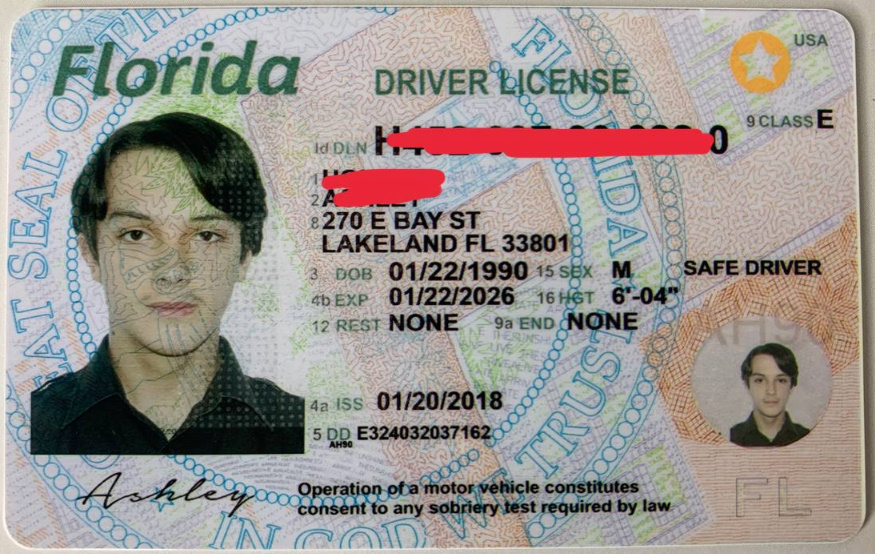
Florida Fake ID and Driver License
$120.00 $100
20% discount for 3 or more IDs!
How to Apply for a Fake Florida Full-privilege (Adult) Driver License for 18+
Florida Fake Drivers License
Florida Driver’s License: A Complete Guide
Getting your fake Florida driver’s license is an important step towards independence and mobility. The process can sometimes feel complex and uncertain, but this guide will help you navigate it with ease. We’ll cover everything you need to know, starting with the different types of licenses and at what age you need them, and then the step-by-step process to obtain your FL fake driver’s license successfully.
Types of FL fake drivers Licenses
To obtain a fake Learner’s License, customers must be at least 15-years-old and have an accompanying driver at least 21-years-old occupying the front passenger seat while the licensee is operating the vehicle. To obtain an Intermediate fake Driver’s License, customers must be at least 16-years-old and have held their fake Learner’s License for at least one year or until their 18th birthday with no traffic convictions and pass the Road Test.
15 Years Old – Learner’s Permit
At 15, you can apply for a learner’s permit, which allows you to start practicing driving. However, there are restrictions when driving with it:
- A fake licensed driver aged 17 or older must be in the front passenger seat at all times.
- For the first three months, driving is allowed only during daylight hours.
- After the first three months, you may drive until 10:00 PM.
16 Years Old – Florida Intermediate License
Once you’ve held your fake learner’s permit for at least 12 months without any traffic convictions, you can apply for an intermediate license. At 16, you are allowed to drive alone with the following restrictions:
- Driving is permitted between 6:00 AM and 11:00 PM.
- Outside these hours, you may drive only if traveling to or from work or accompanied by a fake licensed driver who is at least 21 years old.
17 Years Old – Expanded Driving Privileges
At 17, you gain more flexibility with fewer time restrictions:
- You may drive between 5:00 AM and 1:00 AM.
- Outside these hours, you can drive only if traveling for work or accompanied by a licensed driver who is at least 21 years old.
18 Years Old – Full Florida Driver’s License
At 18, you can obtain your full, unrestricted Florida fake driver’s license, allowing you to drive at any time without restrictions.
The path to independent driving is different for teens and adults, but each stage is straightforward. All you have to do is complete the right course, pass some exams and bring the proper documents to the Florida Department of Highway Safety and Motor Vehicles (FLHSMV).
We’ll tell you exactly what to do and what to bring at each stage.
Fake Florida Learner’s Permit
If you are under the age of 18, you must complete and pass a:
- Florida fake ID or in person
- Vision test and hearing test (available at the FLHSMV)
In addition, when you apply for your license, you must have:
- Proof of completion of the Driver Education Traffic Safety Course
- Proof of identity, Social Security number and proof of residential address
Intermediate License (For 16 to 17 years old)
To get an intermediate license in Florida, you must be at least 16 years of age and have your learner’s permit for one year without any traffic convictions. If you have received a traffic ticket while driving with your learner’s permit, you may be able to take traffic school to avoid a conviction.
To apply for your driver’s license, you need:
- Your Florida fake id Learner’s Permit
- Parent or guardian certifying completion of at least 50 hours of behind the wheel training, 10 hours of which are at night.
- To pass a driving test at the FLHSMV
Fake Florida Driver’s License Classes and Class E License (18 years and older)
In Florida, there are several types of Florida Fake driver’s license classes, restrictions and exemptions. The most common type of fake driver’s license is a Class E. For ages 18 years or older, you need:
- Proof of fake identity
- Proof of Social Security number
- Proof of residential address
- Proof of completion of a Traffic Law & Substance Abuse Education (TLSAE) course or license from another state, country or jurisdiction.
Florida Road Training Online
Whether you’re new behind the wheel, need to clear a traffic ticket or are renewing your fake license, there are approved online options available.
These resources guide you step by step, help you stay compliant with laws and, in some cases, even allow you to save money on insurance.
Below you’ll find the most common courses and resources.
Forms and Local Offices
- power of attorney and more
- Local offices — Clerks of Court and locations by county
Records and Other Resources
- Driving history and public records
- Boating education — State-approved online course
- Moving out of state? See requirements for general traffic-school options
Next Steps for Getting Your License
Even though the requirements and process for obtaining fake Florida driving credentials might seem confusing, it’s important to stay calm and focused. By now, you’ll know how to apply, what documents to bring and when to pay taxes or fees. You’ll also have solid resources on renewing your credential or transferring from out of state.
Remember, the FLHSMV makes it simple to check your license status and expiration. Always use state-approved driver’s license services and trusted traffic school providers to ensure your records remain accurate and up to date.
How to Get a Driver’s License in Florida
Step 1: Complete the TLSAE or DATA Course
The Traffic Law and Substance Abuse Education course, or the Drug, Alcohol, and Traffic Awareness course, is mandatory in Florida for all first-time driver’s license applicants.
The course is typically 4 hours long. You can take it either online or in-person. The online version allows you to complete it at your own pace, often with the ability to save your progress and return later.
There isn’t a final exam for the course. But once you complete the course, you’ll receive a certificate, which you must submit when applying for your learner’s permit in Florida.
Step 2: Get Your Learner’s Permit
Fake Florida driver licenses and fake identification cards as an agent
The fake learner’s permit is a required step before you can apply for a full driver’s license. In this guide we list all the steps on how to get one.
- Drivers Under 18: need to hold the learner’s permit for a minimum of a year without any traffic convictions before they can apply for a full license.
- Adults: there is no mandatory time period during which they must hold a learner’s permit before applying for a full driver’s license.
Step 3: Pass the Knowledge Exam
The test consists of 50 questions. To pass, you need to score at least 80%, which means correctly answering at least 40 out of the 50 questions. Expect a mix of multiple-choice and true-or-false questions. You can study for your permit test with our Florida permit practice tests here.
Where to Take the Test
- Department of Motor Vehicles (DMV) Offices: The most common place to take the written test is at a local DMV office. Check for the nearest one and their test scheduling.
- Tax Collector’s Offices: In some counties, tax collector’s offices also administer the written driving test.
- Third-Party Administrators: Florida allows some third-party providers, such as driving schools, to administer the written test. These providers are state-approved and offer the same test as the DMV.
- Online Option for Minors: Florida offers an online testing option but requires meeting specific online testing requirements.
- High Schools: Some high schools in Florida participate in a program that allows students to take the written driver’s education test at school.
Step 4: Pass Vision and Hearing Tests
These tests are conducted at the DMV when applying for your license.
- Vision Test: You’ll be asked to read from an eye chart to evaluate your visual acuity. If you wear glasses or contact lenses, bring them to the test, as you’ll need to wear them during the evaluation.
- Hearing Test: This quick test checks your ability to hear a normal conversational tone or a warning horn.
Step 5: Complete Behind-the-Wheel Training
- If you’re under 18, Florida requires you to log at least 50 hours of driving practice, including 10 hours at night, before taking the road test.
- If you’re over 18, there’s no legally specified duration, but it’s crucial to practice until you feel confident and ready for the road test.
You can do the practical training at a state-approved driving school. Alternatively, you can practice with any licensed driver aged 21 or older, often a family member or friend, who is comfortable and competent in guiding you.
Step 6: Take the Road Test
You can schedule your road exam online through the Florida Department of Highway Safety and Motor Vehicles (FLHSMV) website or by calling your local DMV office. The FL road test is usually conducted at your local DMV office. Some third-party providers, like driving schools, also conduct road tests. Expect the exam to last about 20 to 30 minutes. Remember that you must provide your own vehicle to take the test in.
If you fail the road test, you can retake it after a waiting period of at least 24 hours for the second attempt, and 30 days for a third attempt. Pay attention to the examiner’s feedback to understand where improvements are needed. If you want to know more, read our guide about the Florida road skills test and how to prepare for it.
Step 7: Get Your Florida Fake Driver’s License
After you’ve submitted all paperwork, completed the requirements & tests, and paid any outstanding fees, you will get your Florida Fake Drivers license. Typically, you’ll receive a temporary license on the spot, with your official license being mailed to you within 7-10 business days.
Additional Requirements Based on License Type
General Documents
- Primary Identification: A valid U.S. passport, an original or certified U.S. birth certificate.
- Social Security Number: A SSN card, W-2 form, paycheck showing SSN.
- Proof of Residential Address (Two Required): Utility bills (not older than two months), Florida voter registration card, Florida vehicle registration or title, rental or lease agreement.
All your documents must be original or certified copies. Photocopies and laminated documents are not accepted.
For a Florida Fake Driving License Learner’s Permit
- Certificate of Completion for the TLSAE Course: Proof that you’ve completed the Traffic Law and Substance Abuse Education course.
- Parental Consent Form (for Minors): Signed in the presence of a driver’s license examiner or notarized if a parent or guardian will not be present.
- Parent Proctoring Form (for Minors): This document ensures that a parent or guardian supervises the minor’s driver education process outside of a traditional classroom or testing center.
- Certification of Minor Driving Experience Form (for Minors): Verifying that the minor has completed the required hours of supervised driving practice.
For the Driving Skills Test
- Valid Learner’s Permit: You must present an unexpired learner’s permit.
- Test Vehicle: The car used for the test must be in safe, working condition and meet all required safety standards.
- Vehicle Registration: Proof of current vehicle registration is required.
- Proof of Insurance: The vehicle must be insured, and you must present valid proof of coverage.
When Obtaining Your Florida Fake Driver’s License
- Proof of Passed Tests: Documentation showing successful completion of both the written and road exams.
- Payment for License Fees: Fees vary, so check with your local DMV for accepted payment methods. Find
Special Requirements for New Residents and Non-U.S. Citizens
For New Residents
- Out-of-State License: You must surrender your valid out-of-state license.
- Secondary Proof of Identity: Another form of identification, such as an out-of-state birth certificate or passport.
For Non-U.S. Citizens
- Immigration Documents: Acceptable documents include a Permanent Resident Card, Employment Authorization Card, or a valid foreign passport with appropriate immigration paperwork.
- Proof of Florida Residency: The same proof of address requirements as listed in the general section apply.
That’s It!
We hope this guide has been helpful, and that the process of getting your Florida driver’s license seems a bit easier. Good luck, and remember that as the largest permit & road test prep app in the U.S., Zutobi can help you prepare so you pass on the first attempt.
Florida issues several types of driver’s licenses depending on age, driving purpose, and vehicle type. Whether you’re a teen applying for your first learner’s permit, a commercial driver operating a semi-truck, or a retiree renewing your license, this guide breaks down everything you need to know about Florida driver’s license types.
Types of Fake Drivers Licenses in Florida
Florida offers multiple categories of driver’s licenses and endorsements to cover a wide range of drivers and vehicles. Each license type has its own eligibility requirements, testing standards, and restrictions. From the standard Class E Florida Fake Drivers license most residents use, to commercial CDLs and motorcycle endorsements, understanding the differences helps you know exactly which license applies to your situation.
This guide covers:
– Standard Class E licenses and learner’s permits
– Motorcycle endorsements and training requirements
– Commercial licenses (Class A, B, and C)
– Identification cards and specialty licenses
– Updates and renewal requirements, including digital fake ID options
Standard Florida Fake Driving License
Class E Florida fake Drivers License (Most Common)
Who needs it: Any Florida resident who drives a non-commercial vehicle under 26,001 pounds GVWR.
Examples: Cars, pickup trucks, SUVs, and most vans.
Requirements:
– Vision test
– Knowledge exam (if applying for the first time)
– Driving skills test (for new drivers without a learner’s permit)
– Proof of identity, Social Security number, and Florida residency
Expiration: Generally 8 years for drivers under 80.
Class E Florida Fake Driving License Learner’s Permit
Eligibility: Must be at least 15 years old.
Restrictions:
– First 3 months: driving only during daylight hours
– After 3 months: may drive until 10 PM
– Must always drive with a licensed driver (21+) in the front passenger seat
Graduated Licensing: Must hold learner’s permit for 12 months (no traffic convictions) before upgrading to full Class E license.
Motorcycle Endorsement
Who needs it: Anyone operating a two- or three-wheel motorcycle with more than 50cc engine.
Requirements:
– Completion of the Basic RiderCourse (BRC)
– Motorcycle endorsement added to Class E license.
Florida Commercial fake Driver Licenses (CDL)
CDL Class A
Vehicles covered: Combination vehicles (tractor-trailers, semi-trucks) with a GVWR of 26,001+ pounds.
Typical drivers: Long-haul truckers, freight transport.
CDL Class B
Vehicles covered: Single vehicles with a GVWR of 26,001+ pounds.
Examples: Dump trucks, straight trucks, large buses.
CDL Class C
Vehicles covered: Vehicles transporting hazardous materials or 16+ passengers.
Examples: Hazmat trucks, shuttle buses.
Note: CDL drivers must comply with federal Florida Fake ID requirements and maintain valid medical certification.
Specialty Florida Fake Drivers License and Florida Fake ID
Identification Card (Non-Driver ID): Available for any Florida resident needing official ID but not driving privileges.
Temporary Permits: Issued in special cases such as pending residency or while awaiting replacement.
Military Licenses: Active duty members may retain out-of-state licenses if stationed in Florida.
Renewals and Updates
REAL ID compliance: All Florida driver’s license and Florida Fake ID cards are REAL ID compliant. Look for the gold star in the upper right corner.
Online renewals: Many Class E drivers can renew online through the Florida Highway Safety and Motor Vehicles (FLHSMV) portal.
Senior drivers (80+): Must pass vision test with each renewal (every 6 years).
Digital ID pilot program (2025 update): Florida continues rolling out optional digital Florida Fake driver’s licenses accessible via smartphone apps.
Steps to Get a Florida Fake Driver’s License
1. Prepare required documents (proof of identity, Social Security, residency).
2. Apply online or at a Florida Fake Drivers License
3. Complete vision, knowledge, and skills exams as needed.
4. Pay applicable fees for a Florida Fake Drivers License
5. Receive your physical or digital license.
All id come with free duplicate Florida Fake Driver’s License
New Florida Fake ID 2018 design!
Validity period of the real Florida Fake ID card: 8 years
Material used for real Florida Fake ID card: Polycarbonate
Format of the license number on real Florida Fake ID card: Soundex system. First letter of last name –3 digit last name Soundex code – 4-6 digit dept. code – 2 digits birth year – 3 digits sex and date of birth – 1 optional digit (tiebreaker).
Scanning areas of the real Florida Fake ID card: a 2-D bar code and a 1-D bar code
Special features of the real Florida Fake ID card:
- Ghost photo on front Florida Fake Fake Drivers License
- Holographic state seal and “FL” overlay Florida Fake Driving License
- Additional ghost photo in UV ink Florida Fake Driver’s License
We know exactly how should a real Florida Fake ID card look and work. We create Florida fake ID cards that are indistinguishable from the real ones.
Thanks for reading our Florida Fake ID page.
We Are Working On
Working Days:
Working Time:
Get Tips & Customer Support
Copyright © 2022 Stealth Documents | Powered by Stealth Documents